
The Future of the Tile Industry: How AI Visualization Is Reshaping the Way We Design Spaces
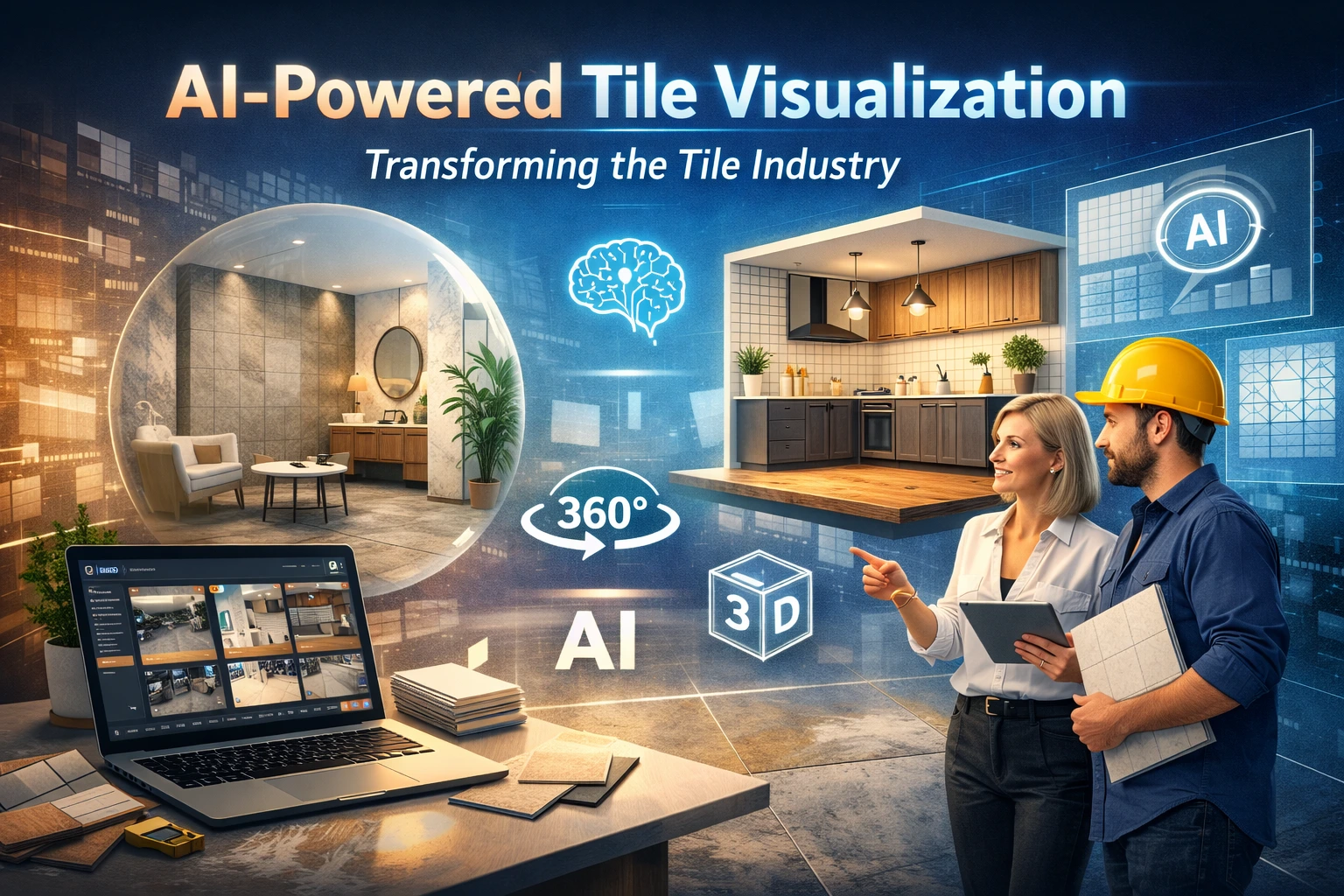
The global tile industry is worth over $400 billion and growing. Demand is rising across residential construction, commercial interiors, and hospitality projects worldwide. Yet for decades, the way tiles have been sold and specified has remained largely unchanged — physical samples, showroom visits, printed catalogues, and a significant amount of guesswork.
That is beginning to change. Artificial intelligence, browser-based software, and digital visualization tools are entering the tile industry in a meaningful way — and the businesses that adopt them early are gaining a measurable edge over those that don't.
This article explores where the tile industry is headed, what forces are driving that change, and how tools like Tiles Visualizer are positioning forward-thinking businesses to lead the next decade.
The Tile Industry in 2026: A Market at an Inflection Point
Several converging trends are putting pressure on traditional tile businesses to modernize:
Customers Expect Digital Experiences
Today's homeowners and commercial buyers research online before they ever walk into a showroom. They watch renovation content, browse design inspiration platforms, and arrive at purchase decisions with high visual expectations. A static product photo in a catalogue no longer meets that bar. Customers want to see how a tile looks in a space that resembles their own.
Project Timelines Are Getting Shorter
Contractors, developers, and interior designers are under increasing pressure to deliver projects faster. Every revision cycle — every time a client changes their mind on a finish or layout after work has begun — adds cost and delay. Tools that help lock in decisions earlier in the process directly reduce project risk.
Returns and Rework Are Expensive
The tile industry has a significant problem with post-purchase regret. Tiles are purchased, installed, and then found to look different than expected under real lighting or alongside actual furniture. Returns are costly, re-installation is labor-intensive, and the damage to customer relationships is hard to repair. Reducing this friction is one of the biggest commercial opportunities in the industry today.
Remote and Hybrid Work Has Changed Where People Live
The post-pandemic shift toward remote work triggered a global renovation boom. People are upgrading homes they now spend more time in. Bathrooms, kitchens, and living spaces are being redesigned at a rate not seen in decades — and buyers are making larger, more considered tile purchases than ever before.
How AI Is Entering the Tile Industry
Artificial intelligence is not a single technology — it's a set of capabilities that apply differently across industries. In the tile business, the most immediately impactful application of AI is visualization: the ability to show customers, designers, and specifiers exactly how a tile will look in a real or simulated space, at scale, with realistic light and perspective.
This is precisely what Tiles Visualizer is built to do.
AI-Powered Surface Mapping
Traditional visualization tools required users to manually outline surfaces — drawing a mask around a floor or wall before a tile texture could be applied. This was slow, technically demanding, and produced inconsistent results.
Modern AI surface detection eliminates this step entirely. Upload a photo of a room, and the software automatically identifies floors, walls, and other tiled surfaces. The tile texture is then applied with correct perspective, scale, and lighting — producing a result that looks like the tiles were actually installed, not digitally pasted on.
Browser-Based Access Without Barriers
One of the historical barriers to visualization software in the tile industry was the technology requirement: expensive workstations, proprietary software licenses, and trained operators. This made advanced visualization the domain of large architecture firms and high-end design studios.
Browser-based tools like Tiles Visualizer have removed those barriers entirely. Any retailer, contractor, or homeowner with an internet connection and a modern browser can access professional-grade tile visualization within seconds — no download, no installation, no training required.
360° and 3D Room Environments
Flat image overlays are useful, but they only tell part of the story. The real test of a tile is how it feels across an entire room — how it transitions at corners, how it reads under different lighting conditions, and how it interacts with other surfaces like cabinetry, countertops, and fixtures.
AI-enhanced 360° scene templates solve this problem by placing tiles inside fully rendered three-dimensional environments. Users can preview the same tile across multiple lighting scenarios and room configurations without leaving the browser.
The Business Case for Adopting Tile Visualization Software
Beyond the customer experience, there is a compelling operational and financial case for tile businesses to integrate visualization tools into their sales process.
Faster Sales Cycles
When a customer can see exactly what a tile will look like in their space, the decision-making process accelerates dramatically. Showroom visits that used to require multiple follow-up appointments — each time bringing new samples for comparison — can be compressed into a single session. Sales teams report that visual confidence leads to faster commitments and fewer abandoned carts.
Reduced Returns and Customer Complaints
The visualization previews produced by Tiles Visualizer serve as a shared reference point between the customer and the supplier. When the customer has approved a JPG rendering that shows exactly how the tile will look, post-installation disputes become far less common. This directly protects margin and reduces the cost of after-sales support.
Higher Average Order Value
Customers who can visualize a complete room design — floor, feature wall, trim tiles — are more likely to purchase a coordinated tile package than those choosing a single product from a catalogue. Visualization encourages holistic purchasing decisions, which naturally increases basket size.
Competitive Differentiation in a Crowded Market
Tile retail is highly competitive. Price comparison is easy, and margins are under pressure from both direct importers and large-format home improvement chains. Offering an AI-powered visualization experience — one that a competitor down the street cannot match — is a genuine differentiator that justifies premium positioning and builds long-term customer loyalty.
Reduced Reliance on Physical Samples
Physical tile samples are expensive to produce, ship, track, and retrieve. Many samples are never returned. Visualization software dramatically reduces the number of physical samples required to close a sale — customers narrow down to one or two finalists digitally, then request samples only for those specific options. This reduces sample overhead across the business.
What the Next Five Years Look Like for Forward-Thinking Tile Businesses
Digital Catalogues Will Replace Physical Ones
The printed tile catalogue is already declining in relevance. Within the next five years, the leading tile businesses will maintain fully digital, interactive catalogues where every product can be previewed in a room environment with a single click. Static PDFs and brochure racks will be replaced by shareable links and embedded visualization widgets.
Visualization Will Become a Sales Standard, Not a Premium Feature
Today, offering digital tile visualization is a differentiator. Within a few years, it will be a baseline expectation — the same way an e-commerce presence shifted from competitive advantage to table stakes over the past decade. Businesses that delay adoption will find themselves at a disadvantage as customer expectations normalize around digital previews.
AI Will Assist With Tile Pairing and Design Recommendations
Beyond visualization, the next generation of AI tools in the tile industry will make active design recommendations — suggesting complementary tiles, optimal grout colors, and layout patterns based on the style of the room being renovated. This moves the software from a passive viewing tool to an active design consultant, further reducing the sales effort required to close a complex specification.
Remote Selling Will Become the Norm
The combination of digital visualization and high-resolution JPG exports means that a complete tile specification can be agreed upon without the customer ever visiting a showroom. For retailers, this dramatically expands the addressable market beyond local geography. A tile supplier in one city can close a sale with a homeowner or designer in another country — all facilitated by a shared visualization link.
Sustainability Pressures Will Reward Accurate Specification
The construction industry faces increasing pressure to reduce material waste. Over-ordering tiles, cutting the wrong quantities, and replacing tiles due to poor upfront decisions all contribute to unnecessary material waste. Accurate digital visualization upstream reduces the likelihood of specification errors downstream — aligning the tile industry with broader sustainability goals that are increasingly important to corporate clients, architects, and building certifiers.
How Tiles Visualizer Is Built for What's Coming
Tiles Visualizer wasn't designed as a novelty feature — it was built as a core business tool for the tile industry's next chapter. The platform reflects the direction the industry is heading:
It runs in the browser, meaning any team member or customer can access it without IT involvement. It accepts uploaded room photos, meaning it works with real spaces — not just idealized templates. It allows tiles to be applied to floors, walls, or both, covering the full range of tile specification scenarios. It produces downloadable JPG outputs that function as design records, client approvals, and sales collateral. And it eliminates the manual labor that has historically made professional visualization inaccessible to small and mid-sized tile businesses.
For businesses evaluating where to invest in technology, the tile visualization category offers one of the clearest return-on-investment stories in the industry: faster sales, fewer returns, larger orders, and a differentiated customer experience — all from a tool that requires no hardware and no training to deploy.
Frequently Asked Questions
Is digital tile visualization only useful for residential projects?
Not at all. Commercial projects — hospitality, retail, healthcare, and office fit-outs — benefit enormously from visualization tools. Stakeholder alignment is often more complex in commercial projects, and having a photorealistic rendering to present in board meetings or client reviews accelerates approval processes significantly.
How does Tiles Visualizer handle different tile sizes and patterns?
The AI surface mapping adapts to the tile dimensions you upload, maintaining correct scale relative to the room. Whether you're previewing a small mosaic, a standard 60x60cm format, or a large 120x60cm slab, the rendering reflects accurate proportions.
Can multiple stakeholders review the same visualization?
Yes. The exported JPG can be shared instantly via email, WhatsApp, or any messaging platform — making it easy for homeowners, designers, contractors, and suppliers to all work from the same visual reference.
Does the software work for outdoor tile applications?
Tiles Visualizer supports a range of space types, including outdoor and semi-outdoor environments. You can upload a photo of a terrace, courtyard, or garden path and preview how outdoor tiles will look in that specific setting.
How does a tile retailer get started with Tiles Visualizer?
Getting started requires no technical setup. Visit ai.tilepreview.com, upload a tile image and a room photo or choose a template, and you'll have a photorealistic preview within minutes. Pricing plans are available at tilepreview.com/pricing for businesses looking to integrate it into their sales workflow.
The Bottom Line
The tile industry is at an inflection point. Customer expectations are rising, project timelines are compressing, and the cost of poor upfront decisions is growing. The businesses that will lead the next decade are those that invest now in tools that bring visual certainty to the specification process.
AI-powered tile visualization isn't a future technology — it's available today, it requires no specialist skills, and it delivers a measurable return from the first sale it helps close.